




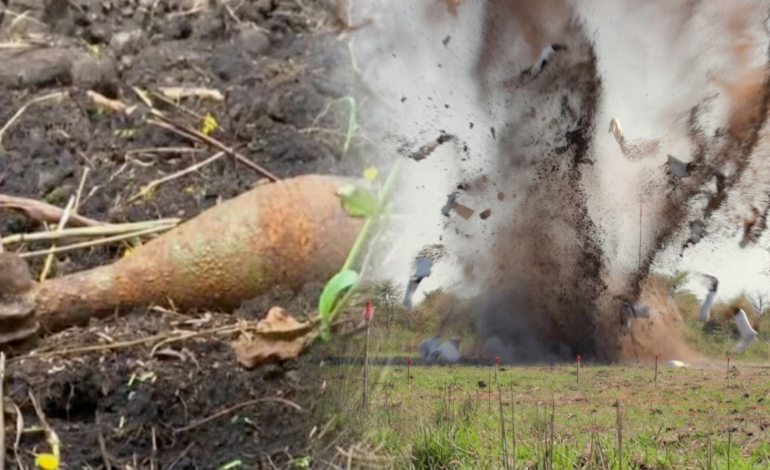

The United Nations Mine Action Service (UNMAS) has destroyed explosive remnants of war across South Sudan with support from the Netherlands.
In coordination with national authorities, UNMAS destroyed more than 7.3 million items of small arms ammunition and 1.2 million explosive devices.
Among the many areas the joint operation was conducted extensively in the town of Bilinyang, 25km east of the capital Juba, that were left littered with landmines, unexploded ordnances, and abandoned ammunition, according to the United Nations Mission in South Sudan (UNMISS).
The civil wars that plagued South Sudan for decades leaving a deadly legacy of millions of explosive remnants that have killed or injured more than 5000 people in the last 20 years, the mission said.
The Netherlands is a core donor to mine action and stabilization efforts in South Sudan, and it is channeling flexible multi-year funding through UN agencies to clear the deadly devices from the landscape.
Bilinyang and many other villages has lived for years with the presence of explosive remnants of war, said Jurkuch Barak Jurkuch, Chairperson of the South Sudan National Mine Action Authority.
“These hazards, not only, threaten lives, they restrict movement, delay returns, and limit opportunities for farming, trade and daily life,” he noted adding that the communities see mine action not as an abstract concept rather as about safety, access and dignity.
With more than 20 million square kilometers of land still to be cleared, international support is critical to the continuation of these operations.
The UN described the efforts as a deeply emotional experience for the community due to the fact that a terrible accident a few years when a child was killed after stumbling across an explosive item buried in the soil.
However, it said the support is also at risk due to UN-wide financial crisis, which has forced UNMAS to significantly downsize its capacity. Its demining teams have been cut from 19 to eight. Detection dogs and three large, automated mine clearing machines have also been demobilized.
“Mine Action, the work that we are doing, is not just about removing explosive hazards. It’s not just about clearing the land,” says Zehrudin Sukanovic, Chief of the United Nations Mine Action Service in South Sudan.
“It’s about creating the conditions for communities, people, for the nation to recover and rebuild, for the communities to establish a new living area, to maintain their lives, but, also, for the humanitarians to deliver their projects and, for the country, the Government to implement their development projects,” Sukanovic added.
The UN statement indicated that a high-level delegation who paid a visit to Bilinyang was able to see first-hand the impact of that support as she witnessed the destruction of an unexploded ordinance at a demonstration in Bilinyang.
“Being here on the ground is such a different experience, seeing really the tough and dangerous work that is so important for the safety of communities, the renovation of schools and roads and everything needed for the reconstruction of the country,” said Faye Price, Policy Officer for Humanitarian Mine Action at the Kingdom of the Netherland’s Ministry of Foreign Affairs.
“It is also really impactful to see the people behind the mine action activities, who are working long days in the heat trying to build their communities and create a safer environment,” she added.
The tangible impact of UNMAS’ activities is clear in Bilinyang but also across the broader Gondokoro area, where the destruction of 70 anti-tank mines has resulted in people returning from across the country to build a new village in what was once a large minefield.
The UN says the communities in the area now feels settled, stable, and enabled to rebuild their homes and secure the better future they deserve.
Related Stories


Related Stories


Discover more from Matter Zone
Subscribe to get the latest posts sent to your email.