




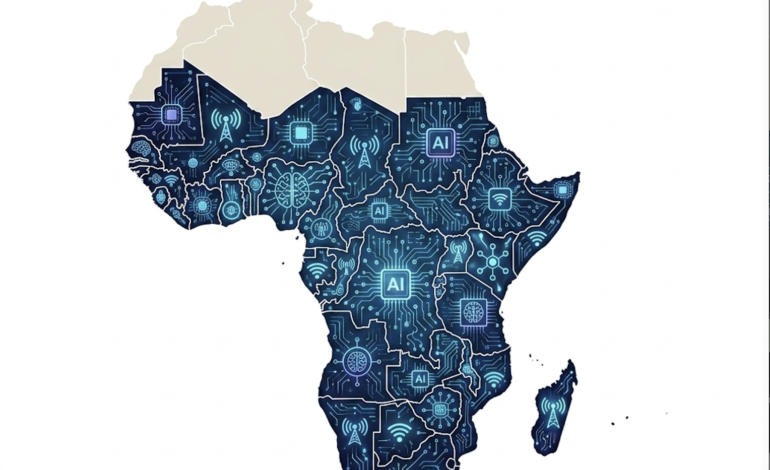

Artificial Intelligence (AI) have the potential to boost Sub-Saharan Africa’s economy by 4% over the next decade with improved electricity supply and internet access and digital skills.
This is according to an International Monetary Fund (IMF) paper released on Tuesday that sets the prospect, while noting the reverse had such reforms are not implemented.
Despite IMF’s raning of the region as lowest on the AI Preparedness Index, the paper indicated that it risks capturing only a fraction of the potential gains if infrastructure bottlenecks remain unaddressed.
AI emerges as a latest major global trend leading countries and companies to race for its economic benefits, investment in data centres, energy infrastructure and digital networks.
Martin Schindler, Deputy Division Chief and Mission Chief in the Fund’s African Department, and the lead author of the paper sees policy to be instrumental in the region’s AI trajectory.
“Policy changes will be key to whether further growth can be unlocked from AI,” Schindler told Reuters adding that without decisive action, many sub-Saharan African countries may see productivity and growth gains of just 0.2% over the next decade,but as “a rounding error”.
Africa remains on the margins of the global AI boom, with Sub-Saharan Africa recording one of the lowest AI adoption rates of any region worldwide, behind every region except South Asia.
The IMF’s AI Preparedness Index attributes the gap to shortfalls in digital infrastructure, technical skills and regulatory capacity that limit both adoption and the region’s resilience to labor-market disruption.
Technological disruption is not a major cause of concern for the region, states the paper, however it is whether Sub-Saharan countries will be able to adopt, adapt, and scale AI quickly enough to capture its benefits and avoid falling further behind.
The prospect of AI investment in the region come against the fact that about half the region’s population have no access to reliable electricity.
To help create local digital hubs, the report recommends targeted grid and mini-grid investments around schools, clinics and other public facilities.
Co-author Andrew Tiffin stresses the paramount importance of power source. “It’s hard to have anything without electricity,” he said adding that the arrival of AI essentially added a new wrinkle to Africa’s longstanding electricity problem.
However, he sees opportunity in data centers, which could emerge as a new bankable project that speed up electrification.
The report also saw connectivity as another constraint, because only 38% of Africans used the internet in 2024, compared with 68% globally. The paper also saw greater investment in fibre backbones and open-access networks could help lower costs and expand access.
Some private-sector investors are already betting on growing AI demand. Microsoft and G42 have announced a $1 billion, 100 MW geothermal-powered data center campus in Kenya; Cassava Technologies and NVIDIA have struck a $700 million deal to deploy 12,000 GPUs across South Africa, Nigeria, Kenya, Egypt, and Morocco.
Africa hosts only about 160 data centres, around 5.5% of the global total, with nearly half located in South Africa, Nigeria and Kenya, highlighting the risk that AI investment could widen regional inequalities, the report said.
Related Stories


Related Stories


Discover more from Matter Zone
Subscribe to get the latest posts sent to your email.