




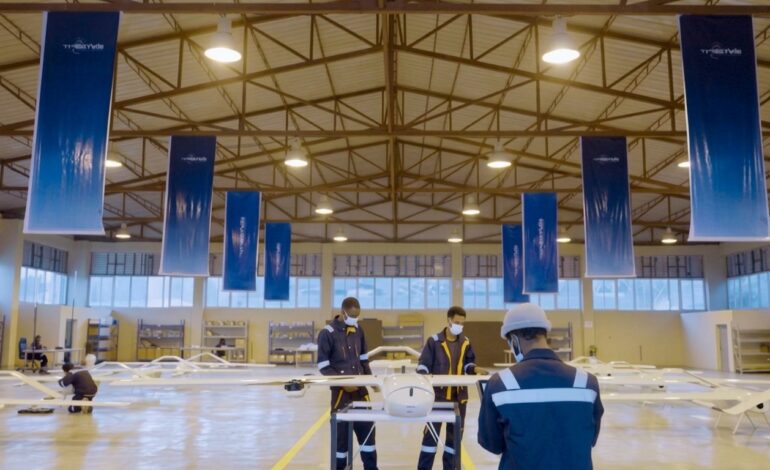

Ethiopia has expended domestic drone manufacturing for military and civilian purposes.
The French Press Agency (AFP) report claims that the country’s government installed two factories manufacturing drones in its operations against armed groups in several regions.
Estimated to possess drone fleet numbering in the thousands, the country boost its capability following the 2020 – 2022 war in northern region of Tigray.
During that war Turkish-made drones made popular by the federal government unmanned air power played a significant role in shifting the conflict by pushing Tigrayan forces back after they had advanced close to the capital Addis Abeba.
With growing interest for bomb-carrying drones among rebels especially the Amhara Fano forces, the Ethiopian federal army openly claims to operate armed drones across regions in its fight against armed groups in Amhara and Oromia regions.
The East African country’s efforts to develop domestic production became more visible in March 2025, when Prime Minister Abiy Ahmed inaugurated the SkyWin Aeronautics Industries factory in Addis Abeba.
The state-owned Ethiopian News Agency reported at the time that the facility would manufacture unmanned aerial vehicles for civilian and military purposes, describing them as products designed and built by Ethiopian professionals.
Pieter Wezeman, a researcher at the Stockholm International Peace Research Institute, told AFP that observing drones displayed at a factory provided limited information about the country’s actual production capabilities. He said a substantial proportion of the technology or components was likely imported.
Ethiopia has acquired a range of foreign-made drones, including Turkey’s Akinci and Bayraktar TB2, China’s Wing Loong and Iran’s Mohajer-6, according to AFP.
Jeremy Binnie of Janes said the SW01 drone displayed during the SkyWin inauguration closely resembled a commercially available Chinese model.
Binnie said large-scale production of such systems could potentially improve the military’s ability to conduct surveillance and coordinate artillery operations, while some models could also be adapted to carry small explosive payloads.
A second facility, Aeroabay, was reportedly opened in late 2025. Wim Zwijnenburg, a drone specialist with conflict-resolution organisation PAX, told AFP that the facility was producing thousands of small weaponised first-person-view (FPV) drones, with individual units reportedly costing between $5,000 and $10,000.
FPV drones allow operators to observe terrain remotely and can be equipped to carry explosive payloads. Some systems use fibre-optic cables for communication, making them less vulnerable to electronic jamming.
The federal government has been facing criticism for civilian deaths on several occasions across regions.
Amid these accusations, Prime Minister Ahmed told MPs elaborating detailed procedure followed during carrying out drone strikes, while senior army officers were heard admitting possibilities of collateral damages.
Related Stories


Related Stories


Discover more from Matter Zone
Subscribe to get the latest posts sent to your email.