




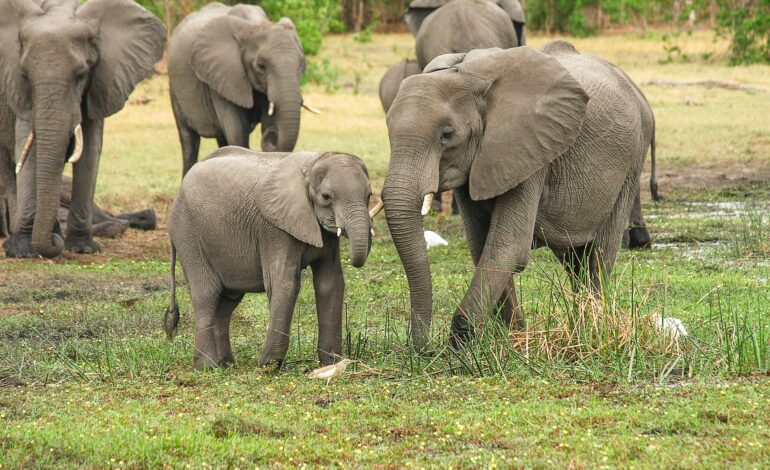

A new study has revealed that African elephants become more isolated due to their fading freedom of movements.
This is according to the largest genomic study of African elephants by the international team that analyzed 232 whole genomes from savanna and forest elephants across 17 African countries.
The largest and first continent-wide study published in the journal Nature Communications found that the damage is already visible in the elephants’ DNA against the elephants population shaped by movement.
For thousands of years, they crossed huge stretches of the continent, mixed with distant herds, and kept their populations genetically strong.
“Our study shows that until recently, elephants have been connected across vast distances. This freedom of movement has created genetic robustness because the populations have intermingled,” said study lead author Patrícia Pečnerová of University of Copenhagen and Lund University.
“Today, the picture is different. Elephants are living in a world where space is more and more restricted and some populations are becoming isolated,” said Pečnerová.
The shift has been driven by a familiar mix of pressures. Hunting, expanding human populations, farming, roads, and other infrastructure have all carved up the landscapes elephants once moved through more freely.
The result is a continent where some elephant populations are now cut off from one another, with clear genetic consequences.
The starkest examples came from north-eastern Africa. In Eritrea and Ethiopia, the researchers found small and highly isolated elephant populations living more than 400km from the next nearest herds.
These elephants are hemmed in by human settlements and agricultural land. Their genomes show high inbreeding, low genetic variation, and a build-up of mildly harmful mutations.
That combination can make a population less able to cope with disease or environmental change. A small, isolated group may survive for a time, but it becomes more fragile.
West Africa showed a related but more complicated pattern. There too, elephant populations have been reduced and isolated over time, partly because of dense human settlement and a long history of ivory hunting.
However, savanna elephants in west-central Africa did not show the same degree of lost genetic variation seen in Eritrea and Ethiopia, even though they were also inbred.
The reason seems to be that forest elephant genes entered these populations through hybridization, helping mask some of the genetic losses.
That finding fits into one of the study’s more surprising conclusions. Savanna and forest elephants are known to hybridize in a few places where their habitats meet, but this research found traces of forest elephant ancestry even in savanna elephants living far from today’s hybrid zones.
Two species, different histories
The study makes clear, though, that hybridization should not be romanticized as a simple conservation fix.
The researchers stress that forest and savanna elephants have followed very different evolutionary paths for millions of years.
“By reconstructing their genomic history, we found that savanna and forest elephants followed very different population trajectories over the last four million years, with over 85% of overall elephant genetic variation due to the differences between them,” said study senior author Alfred Roca from the University of Illinois Urbana-Champaign.
“Given this history, gene flow between the species is unlikely to be beneficial, and hybrid elephants should be avoided for translocations.”
“Among savanna elephant populations, historically high connectivity across their range limited regional differentiation. However, there were sufficient genetic differences across southern, eastern, and west-central Africa to suggest that translocations across regions should be avoided.”
That caution matters because translocation is often discussed as a tool in wildlife conservation.
Moving elephants is risky
Moving animals from one place to another can sometimes help struggling populations, but this study suggests that doing so without paying attention to deep genetic history could create new problems.
The researchers found that while savanna elephant populations across southern, eastern, and west-central Africa were long connected enough to prevent sharp regional splits, meaningful differences still developed.
Those differences are enough that moving elephants across regions should not be treated lightly.
Forest elephants though appear to have higher genetic variation and fewer potentially harmful mutations than savanna elephants.
Given how sharply forest elephant numbers have fallen in recent years, that does not solve their crisis, but it does suggest that their genetic health may still offer some short-term resilience.
Why corridors matter
If there is one big message in the study, it is that elephant conservation cannot stop at protecting animals in scattered reserves. Their genetic future depends on whether they can still move through the landscape.
One place where that still seems possible is the Kavango–Zambezi Transfrontier Conservation Area in southern Africa, the huge KAZA region that stretches across five countries.
There, elephant populations remain genetically diverse because they are still connected and able to exchange genes.
“Elephants are extremely intelligent animals that can live close to humans and adapt. But one of the most important forces for their evolution is that genes can move between populations,” Pečnerová said.
“In southern Africa, the landscape still allows movement between protected areas, and here we see that the genetic health of the elephants remains relatively intact.”
Without those links, even populations that seem secure today may begin to weaken genetically over time.
Broader implications of the study
The old routes that once let elephants move, meet, and mix are disappearing, and the scientists suggest that this loss may be one of the quietest but most serious threats they face.
Study co-author Chris Thouless is Director of Conservation at Save the Elephants and Director of the Elephant Crisis Fund.
“This study reminds us that we cannot understand or conserve elephants without knowing their history, and that they have always been in flux, especially in response to human impacts and climate change,” said Thouless.
“The finding that recent and ancient hybridization between the two species extends over such a large part of both species’ range is particularly interesting.”
“The evidence of inbreeding in isolated and depleted savanna elephant populations is a matter of concern, especially since the samples on which this study is based date from before the recent period of intense poaching for ivory.”
Source: earth.com
Related Stories


Related Stories


Discover more from Matter Zone
Subscribe to get the latest posts sent to your email.