




IMF forecasts Africa’s economy to reach $3.32tn in 2026 with ten countries in lead
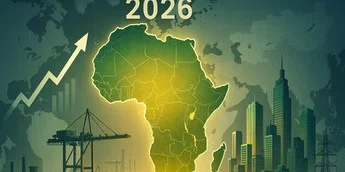

Africa’s economy is expected to reach $3.32 trillion in 2026, while most of that growth will come from a handful countries. The International Monetary Fund (IMF) estimates the top 10 economies alone are projected to generate nearly 68% of the continent’s total output, implying how concentrated Africa’s economic weight still is.
At the top are South Africa, Egypt, and Nigeria, whose combined economies exceed $1.17 trillion.
South Africa at $401.58 billion remains the largest, supported by a diversified industrial base and advanced financial markets. Egypt $399.51 billion follows closely, driven by large scale infrastructure projects and economic reforms, while Nigeria at $334.34 billion continues to balance its vast population potential with ongoing diversification beyond oil.
“Their paths to prominence could hardly be more different, yet together they form the gravitational center of African commerce,” observes Des H Rikhotso, a business executive and analyst.
Beyond the leading trio, emerging regional anchors such as Algeriac ($222.61 billion), Morocco ($158.56 billion), Kenya ($141 billion), and Ethiopia ($161.24 billion) are shaping trade and innovation corridors.
Kenya in particular stands out as East Africa’s financial and technological hub, largely credited to its mobile money ecosystem and expanding logistics infrastructure.
The analyst sees this as a pattern of concentrated growth rather than broad based development, which has significant implications for investment decisions, infrastructure spending, and regional stability.
“Understanding Africa’s economic geography has become essential to navigating the continent’s future,” he writes on The Habari Network, emphasizing that growth trends are heavily influenced by a small group of dominant economies.
However, stark disparities remain visible in parts of East and Central Africa where smaller economies continue to struggle with instability and limited industrial capacity.
Rikhotso argues that while concentration raises concerns, it also creates opportunities for spillover growth. “The question is not whether inequality will persist, but whether the momentum generated by the largest players can eventually lift more boats across more harbors,” he notes.
Related Stories


Related Stories


Discover more from Matter Zone
Subscribe to get the latest posts sent to your email.