




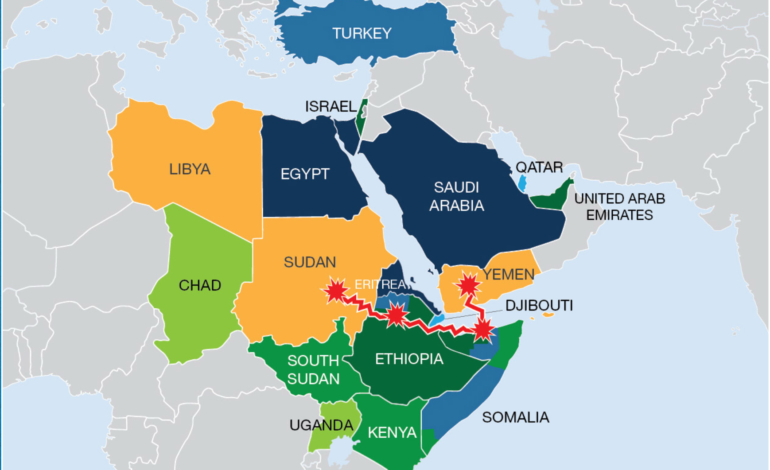

The Horn of Africa has entered a new and volatile phase of geopolitical competition. Since roughly 2020, rivalry among Gulf states and Turkey has increasingly overlapped with preexisting African conflicts, deepening divisions and raising the risk of a broader proxy war across both shores of the Red Sea. What was once a set of largely domestic or subregional disputes has evolved into an interconnected strategic theater linking East Africa to Middle Eastern power politics.
At the center of this shift is the growing involvement of so called middle powers, particularly the United Arab Emirates, Saudi Arabia, Qatar, Turkey, and Egypt. Their competition has mapped onto fragile political transitions, civil wars, and unresolved interstate tensions in Ethiopia, Somalia, Sudan, Eritrea, and Djibouti. The result is not simply foreign interference, but a structural transformation of regional conflicts into arenas of strategic contestation.

Strategic Alignments and Emerging Blocs
A loose alignment has emerged between the United Arab Emirates and Israel on one side and a coalition that includes Egypt, Saudi Arabia, and Turkey on the other. These alignments are not formal alliances, yet their policy coordination in the Horn of Africa has created a polarized regional environment.
The United Arab Emirates has positioned itself as a key external partner for Ethiopia and as a major backer of the Rapid Support Forces in Sudan. It has also cultivated ties with local Somali administrations seeking greater autonomy from the Federal Government of Somalia. Israel has paralleled Emirati engagement in Ethiopia and Somalia, reinforcing this axis.
In contrast, Egypt, Qatar, Saudi Arabia, and Turkey have supported the Sudanese Armed Forces and Sudan’s internationally recognized authorities. These states also back the Federal Government of Somalia in its efforts to consolidate national authority. Egypt and Saudi Arabia have strengthened relations with Djibouti and Eritrea, partly to counterbalance Ethiopian ambitions and to contain Emirati influence.
These alignments intersect with long standing regional disputes. Ethiopia’s quest for sea access, its tensions with Eritrea, and its fraught relationship with Egypt over the Grand Ethiopian Renaissance Dam have all taken on new geopolitical weight. External backing has hardened positions, reduced incentives for compromise, and increased the likelihood that domestic crises spill across borders.
Sudan as the Epicenter
Sudan’s civil war is the clearest manifestation of how middle power competition has intensified African conflicts. Approaching its fourth year, the war has devastated the country, killed tens of thousands, displaced millions, and produced one of the worst humanitarian crises in the world. Both warring factions have received varying degrees of external political or material support, which has prolonged the conflict and increased its lethality.
The introduction of advanced weaponry, including armed drones, has enabled sustained offensives and urban warfare. Civilians have borne the brunt of indiscriminate violence and systematic abuses. Sudan’s fragmentation has also created openings for transnational militant networks and external actors seeking influence in a strategic corridor linking the Sahel, the Red Sea, and the Arabian Peninsula.
Sudan is not an isolated case. It is part of a broader pattern in which African political disputes are increasingly embedded within regional rivalries. The longer the war persists, the greater the risk that neighboring states are drawn more directly into confrontation.
Somalia, Ethiopia, and Interconnected Tensions
Somalia remains deeply affected by clan based federal tensions and the struggle between the central government and federal member states. External actors have aligned with competing Somali authorities, turning institutional disputes into strategic contests. Support to different Somali actors risks undermining national cohesion and complicating efforts to combat extremist groups.
Ethiopia faces its own internal strains, including unresolved ethnic federal disputes and the aftermath of a devastating civil war in Tigray. The country’s determination to secure reliable maritime access has added a new dimension to regional politics. Any move perceived as undermining the territorial integrity of neighboring states could ignite conflict, particularly with Eritrea.
The dispute over the Grand Ethiopian Renaissance Dam remains a flashpoint between Ethiopia and Egypt. While negotiations have continued intermittently, distrust persists. The dam symbolizes both Ethiopia’s developmental ambitions and Egypt’s existential concerns over water security. External alignments have sharpened this dispute, linking it to broader competition in the Red Sea basin.
Together, these overlapping crises form a dense web of insecurity. Clan disputes in Somalia, federal tensions in Ethiopia, Sudan’s civil war, and interstate rivalries are no longer discrete issues. They are components of a single strategic landscape increasingly defined by external competition.
The Red Sea as a Unified Theater
For years, policymakers treated the Horn of Africa and the Middle East as distinct arenas. That distinction is no longer tenable. The Red Sea has become a unified geopolitical theater in which events on one shore reverberate across the other.
Heightened tensions between Gulf states and Turkey in the Horn now threaten to destabilize maritime security, energy transit routes, and global trade corridors. The Bab el Mandeb strait remains one of the world’s most critical chokepoints. Any escalation that disrupts shipping or port infrastructure would have global consequences.
Moreover, rivalries in the Horn intersect with ongoing instability in Yemen. Infighting among proxies in Yemen has already illustrated how quickly regional competition can spiral. A similar dynamic in East Africa would multiply humanitarian and security risks.
Risks to United States Interests
The United States maintains partnerships with many of the actors involved in this competition. A regional proxy war would place Washington in an untenable position, potentially forcing it to navigate direct tensions among its own allies. It would also divert attention from shared priorities such as maritime security, counterterrorism, and limiting the influence of Iran and Russia.
Extremist organizations remain active across Somalia and Yemen. A fragmented regional order would offer these groups greater freedom of movement and recruitment. Iran and Russia have already sought to expand their presence in conflict zones, particularly in Sudan. A wider confrontation would create further opportunities for external powers to exploit instability.
A regional war could also generate massive refugee flows and humanitarian emergencies, overwhelming already fragile states and straining international relief systems. The social and economic costs would reverberate far beyond the Horn.
Toward a Proactive Diplomatic Strategy
Avoiding a broader proxy conflict requires a shift from reactive crisis management to proactive regional diplomacy. The United States is uniquely positioned to convene and mediate among rival partners. However, mediation must be grounded in realism. It must recognize that African actors possess agency and are not merely proxies. Durable solutions require addressing their security concerns, political grievances, and development needs.
First, sustained high level diplomatic engagement is essential. Washington should communicate clearly that actions undermining regional stability carry consequences. A willingness to impose targeted sanctions against individuals or entities that fuel violence would reinforce this message without alienating entire partner states.
Second, diplomacy should pursue inclusive settlements that offer tangible benefits to all major stakeholders. In Sudan, negotiations must address concerns about political Islam, security sector reform, and the protection of foreign investments while prioritizing civilian governance and accountability. In the Nile basin, renewed efforts to reach a long term understanding over the Grand Ethiopian Renaissance Dam could reduce one of the region’s most persistent sources of tension. Linking water security discussions with broader economic cooperation and infrastructure integration may help reframe the issue as a shared opportunity rather than a zero sum contest.
Third, regional architecture needs reform. Existing Red Sea forums exclude key actors and therefore lack the legitimacy and leverage to mediate disputes effectively. A more inclusive framework that brings together African and Middle Eastern stakeholders could provide structured channels for dialogue, crisis management, and confidence building.
Fourth, coordination with other mediators can amplify impact. Qatar and Turkey have demonstrated experience in facilitating negotiations in complex conflicts. The African Union remains central to resolving the domestic dimensions of African crises. A multilateral approach that integrates international and regional institutions would distribute diplomatic burdens and enhance credibility.
Fifth, appointing a dedicated envoy focused on the Horn of Africa would strengthen continuity and coherence in engagement. The complexity of the region demands sustained attention and the authority to coordinate across agencies and with Congress.
Finally, economic instruments matter. Development finance and debt relief can reduce the appeal of transactional partnerships that tie political loyalty to short term funding. By expanding access to diversified financing, the international community can help depoliticize infrastructure investment and support long term growth.
Conclusion
The Horn of Africa stands at a crossroads. Middle power rivalry has transformed local conflicts into components of a broader strategic competition that spans the Red Sea. Without deliberate and coordinated diplomacy, the region risks sliding into a prolonged proxy confrontation with devastating humanitarian and geopolitical consequences.
Stability will not emerge from isolating the Horn from Middle Eastern politics. It will come from recognizing the Red Sea as a shared security space and building inclusive arrangements that address the legitimate interests of African and Middle Eastern actors alike. The window for preventive action is narrowing. A coherent strategy that blends pressure, mediation, and economic support offers the best chance to avert escalation and lay the foundation for a more stable regional order.
This text is extracted from a report by Liam Karr and Michael DeAngelo & published by American Enterprise Institute
Read Full Report here
Related Stories


Related Stories



Discover more from Matter Zone
Subscribe to get the latest posts sent to your email.
