





Sudan’s Foreign Minister Mohieddin Salem has rejected United States position that delegitimized leadership in the country.
The push back came as US State Department official said “neither the Sudanese Armed Forces, the Rapid Support Forces (RSF), nor their respective leaders, represent legitimate, constitutional governance for Sudan.”
The US description came during an unprecedented meeting of the Quad and Quintet on Sudan, which was co-chaired by the African Union (AU) Commission Chairperson Mahmoud Ali Youssouf and Massad Fares Boulos, US Senior Advisor for Arab and Africa Affairs.
Boulos took aim at both warring factions, saying neither parties has a legitimate mandate to rule.
Salem said at a press conference on Friday in New York that his government is “open to dialogue” but will not accept external interference or externally imposed solutions on his government.
The unprecedented joint meeting on Wednesday seek to unify fragmented international initiatives to end the devastating war in Sudan.
Youssouf warned that the crisis requires immediate operational coordination, not diplomatic rhetoric, reiterating that there is no military solution to the conflict, and demanded for an immediate humanitarian truce and a cessation of hostilities to open the way for a durable ceasefire, while firmly rejecting any territorial division of Sudan.
He emphasized that any future political roadmap must be Sudanese-led and Sudanese-owned to restore constitutional governance and preserve the country’s sovereignty and territorial integrity.
The AU chief also urged an immediate halt to external military assistance fueling the fighting, insisting that political negotiations, humanitarian delivery, and security measures must move in parallel.
“Khartoum’s position is based on its commitment to national sovereignty and the territorial integrity of Sudan,” he said accusing external parties of financing and arming it and the RSF of rebelling against the army describing the war as “imposed on the people of Sudan.”
Contingent on Sudanese army chief Abdel Fattah al-Burhan agreeing to a 90-day ceasefire, the US withheld a visa ahead of his scheduled visit to New York for the United Nations annual summit.
Khartoum says it “upholds its national sovereignty” while calling on Washington to engage positively with the African country’s government.
UN Secretary-General Antonio Guterres expressed concern over the failure to issue the visa, while Khartoum raised the issue of US obligations as the host country of the UN headquarters.
The US maintains that neither the Sudanese army nor the RSF represent legitimate constitutional governance for Sudan, pushing instead for a complete cessation of hostilities, expanded humanitarian aid, and an inclusive civilian-led political process.
“The Sudanese people deserve a humanitarian truce that facilitates Sudanese-Sudanese dialogue,” Boulos said. “Neither the SAF nor RSF represent legitimate, constitutional governance for Sudan. We need to expand the UN arms embargo and raise the cost of conflict on all combatants.”
European Union Special Envoy for the Horn of Africa Annette Weber said the gathering signalled a unified international posture on the crisis.
“The first time our two platforms – Quintet and Quad – came together at UNGA81. Joining hands and coordinating our efforts on and for Sudan much closer is our committment and signal from New York,” Weber said.
Executive Secretary of the Intergovernmental Authority on Development Workneh Gebeyehu warned that diplomatic momentum must translate quickly into relief for civilians on the ground.
“Sudan needs the full weight of regional and international partners working together,” Gebeyehu said, adding that he urged participants to secure unhindered humanitarian access and halt the fighting. “The Sudanese people cannot wait for another round of promises.”
Participants agreed to advance work on a humanitarian declaration, institute civilian protection measures, and lay the groundwork for monitoring and verification mechanisms to support future agreements.
The Quintet emphasized the need to deepen outreach to Sudanese civilian factions, urging coordinated efforts to build a broad-based political coalition.
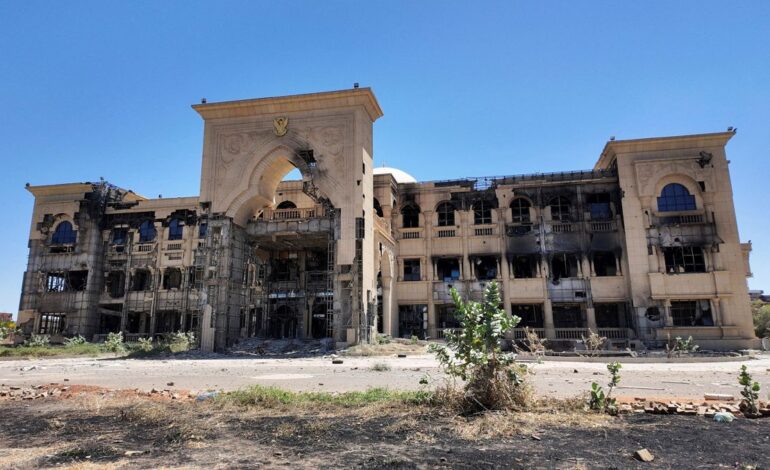
Sudan has been engulfed in a war between the army and the RSF since April 2023 that has killed tens of thousands of people and caused one of the world’s largest displacement crises.
Related Stories


Related Stories


Discover more from Matter Zone
Subscribe to get the latest posts sent to your email.