




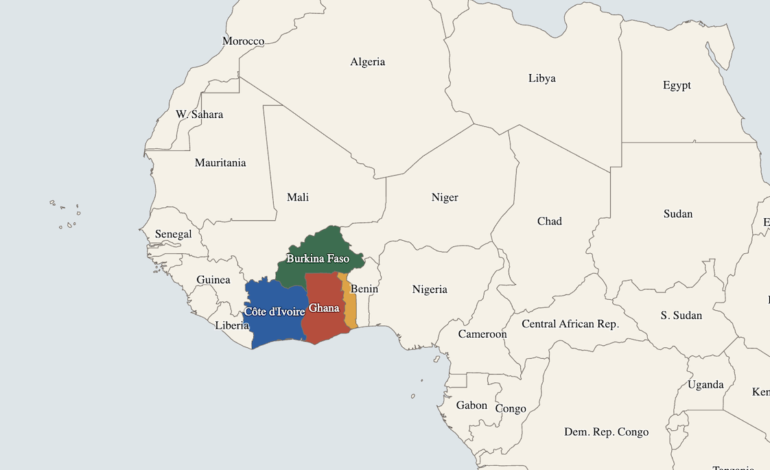

The informal cross-border trade between Ghana and its three neighboring countries have reached nearly $2.7 billion (GH¢31 billion) in the first three quarters of 2025, exceeding the formal trading scheme.
The number emerged as the Ghana Statistical Service (GSS) released the Informal Cross-Border Trade Report that states Ghana’s informal trade with Togo, Burkina Faso and Côte d’Ivoire was about one and a half times the value of formal one.
The report that come as the first continuous measurement of informal trade flows, found the formal trade was $1.7 billion (GH¢20.1 billion) during the same reporting period, confirming informal trade as the main channel of trade among the four west African neighbors.
The report highlighted that informal trade accounted for more than two-thirds of total trade with Togo, about two-thirds with Côte d’Ivoire, and about half with Burkina Faso.
The Ghanaian agency recorded trade surpluses with Burkina Faso and Côte d’Ivoire throughout the period, although the overall trade surplus narrowed sharply from $57.5 million (GH¢665.3 million) in the second quarter to $4.3 million (GH¢49.3 million) in the third quarter due to a widening trade deficit with Togo.
By the third quarter of the reporting period, 49.4% of the informal imports were food products, with cooking oil remaining the largest food import by value. The report found that Burkina Faso served as a main source of livestock import, while Togolese traders sold vegetables and oil seeds.
The statistics tells that Ghana’s informal food trade deficit doubled from about $34.6 million (GH¢400 million) in the first quarter to about $69.2 million (GH¢800 million) in the third quarter.
70% of the transport for export of the informal trade was carried out by men, while women accounted for more than 60% of transporters of imported goods. Tricycles and motorbikes served as major means of transport, reflecting the nature of informal trade among the land borders of the four countries.
The GSS report cited by Daily Graphic indicated that a 14 days data collection targeting 206 active border points in 10 of Ghana’s 16 regions were surveyed between October 2024 and September 2025.
Direct observation of goods crossing the borders and in person interviews with traders were also conducted.
Authorities measured the informal cross-border trade as the first step towards understanding its contribution to Ghana’s economy and ensuring that the evidence informs policy.
“Every trader count, and every trade should be counted,” said Government Statistician Alhassan Iddrisu.
In a bid to transition to formal trading scheme the report recommended simplifying registration and licensing for small traders, while improving access to finance and training.
It also called for investment in border infrastructure and data systems, strengthening cooperation with neighbouring countries, and for Ghana to enhance import substitution of key commodities.
Related Stories


Related Stories


Discover more from Matter Zone
Subscribe to get the latest posts sent to your email.