




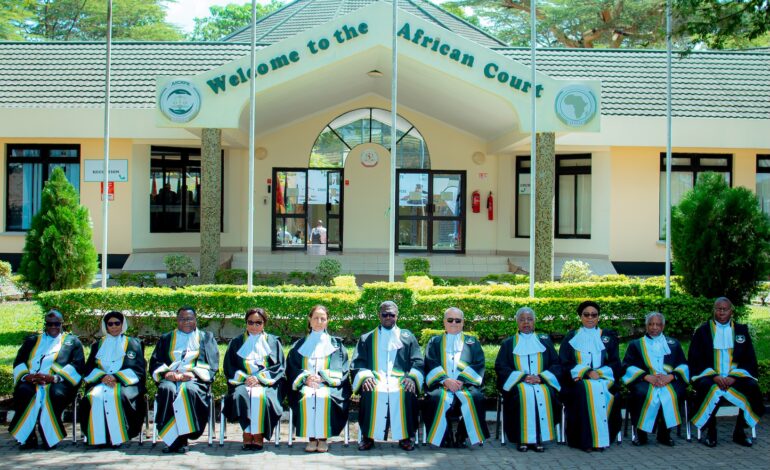

Twenty years after the African Court on Human and Peoples’ Rights began operating in Arusha, Tanzania, Africa’s highest human rights court continues to issue groundbreaking judgments but remains constrained by limited access, weak state compliance, and low public awareness.
In an interview with Justice Info, Amnesty International’s legal adviser for Africa, Alice Banens, said the Court has delivered more than 150 judgments on the merits since its establishment, addressing issues ranging from press freedom and indigenous land rights to environmental justice and the protection of vulnerable groups.
Banens, however, noted that the institution remains “largely unknown” compared to regional courts in Europe and the Americas.
Among its landmark rulings is the 2014 Norbert Zongo case, where the Court ordered Burkina Faso to reopen investigations into the 1998 murder of the investigative journalist and three others, recognizing the broader impact of impunity on press freedom.
Other significant decisions include the Ogiek indigenous land rights case against Kenya and the Probo Koala toxic waste case, in which Côte d’Ivoire was held responsible for failing to protect citizens from environmental and health harms linked to hazardous waste dumping.
Despite these legal milestones, she said implementation remains a major challenge.
Banens observed that many governments have failed to comply fully with Court orders, with Kenya and Côte d’Ivoire among states still lagging in executing judgments.
Civil society organizations have increasingly assumed the responsibility of monitoring compliance and advocating for enforcement.
Access to the Court also remains severely restricted. Although 34 African Union (AU) member states have ratified the Court’s founding protocol, only seven currently allow individuals and non-governmental organizations to file cases directly under Article 34(6).
Over the past decade, Rwanda, Tanzania, Benin, Côte d’Ivoire, and Tunisia have withdrawn this declaration after objecting to judgments against them.
Banens described the withdrawals as a worrying signal for the rule of law, arguing that governments committed to human rights should not fear judicial scrutiny from their own citizens.
She argued also that the Court has demonstrated remarkable judicial independence and has increasingly developed progressive jurisprudence, including a recent ruling on the rights of persons with albinism that sets new international standards for state protection and healthcare obligations.
While state support remains inconsistent, Banens, who specialized in international criminal law and international human rights law, believes growing use of the Court by individuals and civil society demonstrates its continuing relevance in strengthening Africa’s human rights architecture.
Related Stories


Related Stories


Discover more from Matter Zone
Subscribe to get the latest posts sent to your email.