




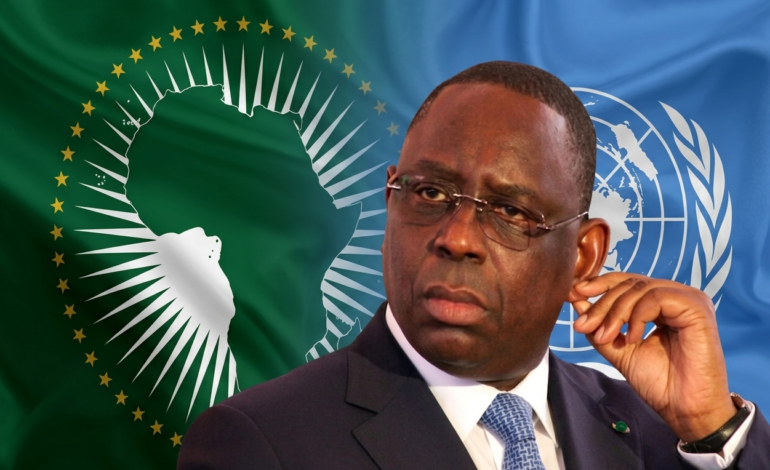

The race to succeed António Guterres as the next United Nations Secretary-General was always expected to be more than a contest of personalities. It is a test of the future of multilateralism at a time when the international order faces unprecedented strain. With Guterres set to leave office on 31 December 2026 after completing the maximum two terms, his successor will inherit an institution grappling with geopolitical rivalry, financial constraints, conflicts, and growing skepticism about the effectiveness of global governance. Against this backdrop, former Senegalese President Macky Sall has emerged as one of the most prominent candidates from the Global South.
Yet, before Sall’s campaign could gain momentum internationally, it encountered its greatest obstacle at home. The African Union’s inability to endorse his candidacy has triggered widespread commentary portraying Africa as divided. Such interpretations, however, overlook a more important reality. This episode is less about African disunity than about the growing maturity of African institutional governance.
The controversy began when Burundi, the current Chair of the African Union, submitted Sall’s nomination to the United Nations shortly after assuming the AU chairmanship. The move was followed by an attempt to secure continental endorsement through the AU’s “silence procedure,” under which decisions are deemed adopted unless member states formally object within a specified period. Twenty member states, including South Africa, Algeria, Nigeria, Rwanda, Liberia, and initially Egypt, broke the silence, preventing the proposal from being adopted. Even Senegal, Sall’s own country, distanced itself from the initiative, stating that it had never officially endorsed his candidacy. According to the ISS, this outcome reflected adherence to AU procedures rather than institutional failure.
Many observers quickly interpreted the decision as another example of Africa’s inability to speak with one voice. That conclusion is overly simplistic. The AU is not designed to manufacture consensus where none exists. Rather, it exists to facilitate legitimate consensus through agreed rules. In this instance, member states insisted that candidacies for major international positions should follow established institutional procedures rather than expedited political arrangements.
The significance of this distinction cannot be overstated. Africa has often been criticized for weak institutional culture and excessive reliance on personalities. Ironically, critics now appear disappointed when African states choose institutional procedure over political expediency. The rejection of Sall’s endorsement did not necessarily represent opposition to his qualifications. Instead, it reflected concerns over process, transparency, and precedent.
Indeed, Sall possesses credentials that few African leaders can match. During his presidency from 2012 to 2024, Senegal recorded significant infrastructure investments, macroeconomic reforms, and increasing diplomatic visibility. As Chairperson of the African Union in 2022, he successfully championed Africa’s permanent membership in the G20, strengthening the continent’s voice within global economic governance. He also emerged as a leading advocate for reforming international financial institutions and promoting greater representation of Africa in global decision-making.
In his vision for the United Nations, Sall argues that the organization requires modernization, institutional reform, and renewed commitment to multilateralism to meet twenty-first century challenges. As reported by Deutsche Welle, has emphasized making the UN more efficient, streamlined, and responsive to emerging global realities.
These priorities resonate strongly with many countries of the Global South. For decades, developing nations have argued that the post-1945 international order no longer reflects contemporary geopolitical realities. Calls for Security Council reform, equitable financing, fairer development partnerships, and greater representation have become increasingly difficult to ignore.
China’s recent engagement with Sall illustrates this broader geopolitical context. During a meeting in Beijing, Chinese Foreign Minister Wang Yi described Sall’s candidacy as reflecting a commitment to safeguarding the interests of Africa and the Global South. Wang further emphasized that the next Secretary-General should uphold the UN Charter, respond to the aspirations of developing countries, and strengthen multilateral cooperation. China also reiterated its intention to play a constructive role in the Secretary-General selection process while supporting stronger African participation within the UN system.
Nevertheless, international endorsements cannot substitute for continental legitimacy. One of the principal weaknesses of Sall’s campaign remains the absence of unequivocal backing from Senegal itself. Equally significant is the long-standing informal regional rotation principle within the United Nations. Many member states believe that after two successive Secretaries-General from Europe and Asia, the position should rotate to Latin America and the Caribbean. Nigeria cited this principle in opposing Africa’s endorsement of Sall, arguing that the continent should respect established diplomatic understandings rather than pursue a candidacy with uncertain prospects.
Africa therefore confronts a strategic dilemma. Should it present a candidate simply because one is available, or should it pursue a broader diplomatic strategy that strengthens its credibility within multilateral institutions? The answer carries implications extending well beyond this particular election.
The United Nations itself recognizes that its next leader will face one of the most demanding transitions in the organization’s history. UN News says the incoming Secretary-General will inherit responsibility not only for managing geopolitical crises but also for advancing reforms necessary to ensure that the UN remains relevant in an increasingly fragmented international system.
Viewed through this wider lens, the AU’s handling of Sall’s candidacy deserves greater recognition than criticism. Rather than endorsing a politically sensitive nomination through procedural shortcuts, member states insisted that established institutional mechanisms be respected. Such restraint reinforces the AU’s credibility as a rules-based organization.
Africa’s greatest contribution to global governance may not lie in securing the next Secretary-General. It may instead lie in demonstrating that its own institutions are increasingly capable of upholding transparency, accountability, and collective decision-making even when doing so produces uncomfortable political outcomes.
Whether Macky Sall ultimately occupies the thirty-eighth floor of United Nations Headquarters remains uncertain. What is already clear is that his candidacy has exposed an important transformation within African diplomacy. The continent is gradually moving from politics driven by personalities toward diplomacy anchored in institutions. That evolution, more than any individual campaign, may prove to be Africa’s most significant contribution to the future of multilateralism.
By Earnest Odindo, Exclusive to Matter Zone
Related Stories


Related Stories


Discover more from Matter Zone
Subscribe to get the latest posts sent to your email.