




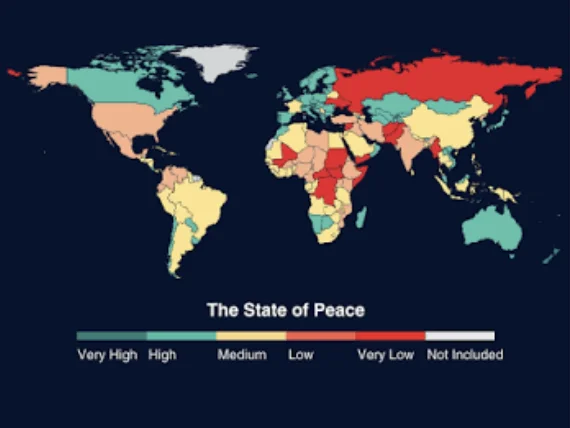

Sub-Saharan Africa remains the third least peaceful of the eight regions says the 2026 Global Peace Index (GPI).
The region recorded a slight deterioration in peacefulness, driven primarily by a 1.9% decline in the ongoing conflict domain, reveals the Index, reflecting continued pressures linked to violent conflict and instability across parts of the region.
The report found Mauritius to be the most peaceful country in sub-Saharan Africa, while Democratic Republic of the Congo (DRC) remains the least peaceful.
The Index identified Sudan’s civil war as the world’s most severe humanitarian crisis, with an estimated 150,000 people killed, over 12 million displaced, and famine confirmed across multiple regions.
Sudan serves as a prime example of how conflict clusters operate, as conflicts in Sudan, Ethiopia, Eritrea, South Sudan, and Somalia are interlocked by refugee flows, proxy sponsorship, and illicit trade, the report noted.
The Index indicated that there withdrawing external state sponsorship will unlikely stop the fighting as gold prices rising to historic highs, which sets the financial incentive to control mines to become skyrocketed.
In a broader perspective, the latest GPI reveales a world struggling with the economic consequences of a record-high number of conflicts that are increasingly interconnected and difficult to resolve.
This deterioration is driven by a profound geopolitical shift, characterised by the rising influence of middle powers and the waning strength of traditional European powers known as the “Great Fragmentation.”
According to the report, the war in Sudan is partially self-financing through gold, where the Rapid Support Forces (RSF) produced an estimated ten tonnes in 2024 alone, worth approximately $860 million.
The report that analyzed the role of drones in frontlines said that for the first time in history, machines are making life-and-death combat decisions faster than any human can review them.
The rapid technological revolution in warfare has left international law and diplomacy far behind because the international frameworks meant to govern them barely exist.
The GPI is produced by the international think tank the Institute for Economics & Peace and has been published annually for the past 20 years as the most comprehensive resource on global peace trends, ranking 163 independent states and territories, covering 99.7% of the world’s population.
It uses multiple indicators to measure the state of peace across ‘societal safety and security’, ‘ongoing domestic and international conflict’, and ‘degree of militarisation’.
By Hasina Omondi
Related Stories


Related Stories


Discover more from Matter Zone
Subscribe to get the latest posts sent to your email.