




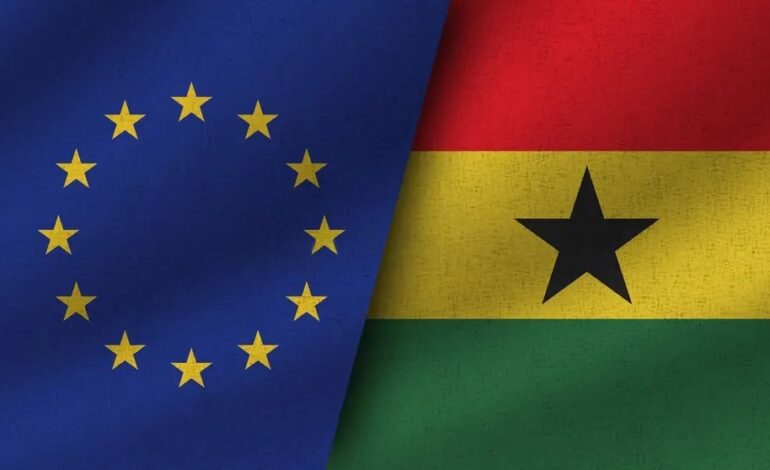

On 24 March, the European Union (EU) and Ghana formalised a Security and Defence Partnership (SDP), inaugurating a new phase in bilateral relations and marking the EU’s first such agreement with an African country.
Designed to deepen cooperation across a broad spectrum of security challenges, from terrorist threats and maritime security to cyber attacks and hybrid threats, the EU-Ghana SDP reflects both actors’ growing recognition of the interconnectedness of security in Europe and West Africa.
Strategic Rationale
The EU-Ghana SDP has been signed amid a deteriorating security environment in West Africa and the infiltration of Islamist groups such as Al-Qaeda and the Islamic State in Ghana’s neighbouring countries. In particular, Burkina Faso, to the north of Ghana, accounts for a large share of global terror-related fatalities and mass displacement. Even though Ghana has not been a victim of large-scale attacks, cross-border instability, increasing refugee inflows, and the killings of Ghanaian traders underscore the fragility of the situation. In this context, the EU-Ghana SDP aims to prevent the spillover of militant Sahelian violence.
As a democratic country with relatively strong armed forces, an extensive history of participation in UN peacekeeping operations, and a prominent leadership role in regional organisations such as the Economic Community of West African States (ECOWAS), the SDP positions Ghana as a key European partner in safeguarding stability across the Gulf of Guinea and the West African region. Meanwhile, by combining sustained political dialogue with concrete operational support, the SDP is an opportunity for the EU to recalibrate its security engagement in West Africa following setbacks in the Sahel, where European missions such as the EUCAP Sahel Niger and EUTM Mali have been suspended.
The Scope of the EU-Ghana SDP
Given the volatile West African security context, the EU-Ghana SDP has a strong focus on counterterrorism, extremism, crisis management, and capacity building. Alongside the agreement, the EU delivered a €50 million package of non-lethal military equipment, including surveillance drones, motorcycles, and anti-drone systems, to Ghana’s armed forces under the European Peace Facility (EPF) package that was initiated in 2023. Such equipment is aimed at supporting regional stability and enabling Ghana to monitor its border areas and respond to terrorist incursions more effectively. Transnational organised crime, intelligence exchange, and border management are key focus areas of the SDP, aimed at countering the ability of militants to exploit porous borders.
Enhancing maritime security in the Gulf of Guinea, a key global trade route vulnerable to piracy, drug trafficking, and other illicit activities, is another core objective. For the EU, strengthening maritime governance in the region is particularly significant for irregular migration management. The SDP provides for European navies to operate alongside the Ghanian Navy under the EU’s Coordinated Maritime Presences (CMP) mechanism for enhanced situational awareness and deterrence, as well as support for the Yaoundé architecture for maritime security in West and Central Africa.
By strengthening Ghana’s security capabilities, the EU seeks to help manage instability and disruptions in West Africa that affect supply chains, migration patterns, and geopolitical competition.
Similar to the EU’s other SDPs with India, Australia, and South Korea, the EU-Ghana SDP integrates non-traditional security domains such as climate and environmental pressures, as well as hybrid threats emanating from disinformation and emerging technologies. The partnership establishes a dedicated annual Peace, Security and Defence Dialogue aimed at providing strategic direction, reviewing progress, and ensuring continuity.
The Broader EU Strategy in Africa
The SDP builds on longstanding EU-Ghana economic ties. Under the framework of the EU-Ghana Economic Partnership Agreement signed in 2016, the EU is Ghana’s largest trading partner and a key market for the latter’s cocoa and other agricultural exports. On the other hand, the EU’s funding programmes in Ghana support urban development, governance reforms, and clean energy under the Global Gateway Initiative, while allocating €339 million for the 2021-2027 period under the Global-Europe Neighbourhood, Development and International Cooperation Instrument (NDICI). By strengthening Ghana’s security capabilities, the EU seeks to help manage instability and disruptions in West Africa that affect supply chains, migration patterns, and geopolitical competition.
More broadly, the SDP forms part of a wider EU effort to recalibrate its engagement with Africa amid shifting global dynamics. As ongoing wars strain European resources and test longstanding relationships such as the transatlantic alliance, the EU is diversifying its partnerships to enhance economic resilience, security, and strategic autonomy. EU engagements with other African countries, such as Nigeria and Senegal, are also intensifying, while prioritising African-led solutions to regional challenges and sovereignty.
Despite its ambitious scope, the EU-Ghana SDP faces certain obstacles. For starters, advanced equipment needs to be combined with technical training to ensure operational effectiveness. Past European experiences in the Sahel have demonstrated the limitations of external support, particularly if domestic political dynamics, local priorities, and community needs are not taken into account. Moreover, despite general approval of Ghanian stakeholders for capacity-building initiatives that emphasise partnership and local ownership, reservations about foreign military assistance are prevalent.
The EU–Ghana SDP reflects a shared recognition that contemporary security threats are transnational, multifaceted, and increasingly intertwined with economic, environmental, and technological factors.For the EU, Ghana offers a reliable partner in a volatile region; for Ghana, the agreement provisions material resources and support to safeguard national and regional security. More broadly, it links two continents where stability and prosperity are increasingly intertwined. While challenges will need to be navigated, the SDP may contribute to a more stable security architecture in West Africa and also reinforce Ghana’s role as a regional anchor, particularly as the country gears up for its Chairmanship of the African Union in 2027.
By Shairee Malhotra, Deputy Director of Strategic Studies Programme at the Observer Research Foundation
Original article published on Observer Research Foundation
Related Stories


Related Stories


Discover more from Matter Zone
Subscribe to get the latest posts sent to your email.