




5,000-year-old discovery opens new perspective of ancient technology
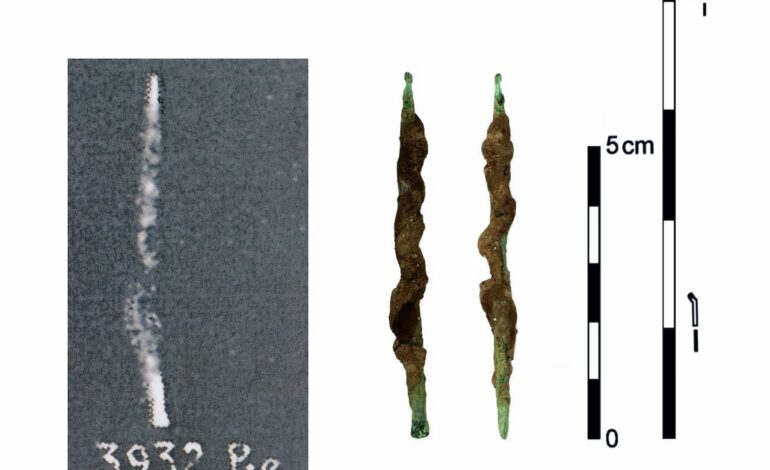

Researchers from Newcastle University and the Academy of Fine Arts in Vienna have had another look at the small copper-alloy object excavated a century from a cemetery at Badari in Upper Egypt.
In their analysis, they concluded that the object was the earliest identified rotary metal drill from ancient Egypt.
The artefact was initially excavated back in the 1920s from a cemetery at Badari and has since been stored in the Museum of Archaeology and Anthropology at the University of Cambridge.
At just 63 millimetres long and weighing around 1.5 grams – it was described as “a little awl of copper, with some leather thong wound round it.”
The object was overlooked in the decades that followed, until now, as researchers put it under magnification, where they found “distinctive wear consistent with drilling: fine striations, rounded edges, and a slight curvature at the working end, all features that point to rotary motion, not simple puncturing.”
In addition, experts also noted the six coils of an extremely fragile leather wrapped around the object and is believed to be a remnant of the bowstring used to power a bow drill. Essentially, this is an ancient version of a hand drill, where a string wrapped around a shaft is moved back and forth by a bow to spin the drill rapidly.
As a result, this technique enables faster and more controlled drilling in comparison to simply pushing or twisting by hand.
For context, Bow drills are well known from later periods of Egyptian history, and so this discovery implies that the technology was around over two thousand years earlier than previously thought.
Source: Indy100
Related Stories


Related Stories


Discover more from Matter Zone
Subscribe to get the latest posts sent to your email.