




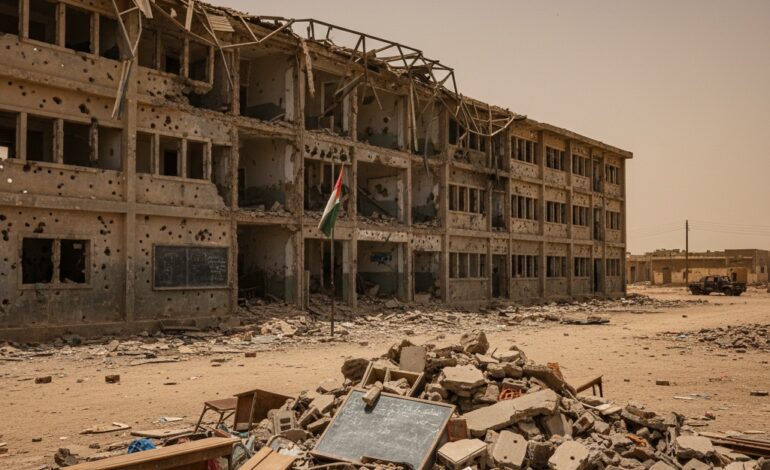

Every year on January 24, the world marks International Day of Education, a day meant to reflect on the transformative power of learning, its role in fostering peace, and the promise it holds for every child. But for millions of children caught in the crossfire of conflict, that promise has turned into an echo of what once was, and might never be again.
Education should unlock doors to opportunity, understanding, dignity. Yet today, in places like Sudan and Ethiopia, war and instability have barricaded those doors shut. The very systems designed to nurture young minds have become collateral victims of violence, displacement, and political fragmentation.
Sudan: A generation locked out of classrooms
Sudan has been thrust into what humanitarian organizations have called the “worst education crisis in the world.” Since fighting erupted in April 2023 between the Sudanese Armed Forces and the Rapid Support Forces, the country’s education system has collapsed under the weight of insecurity and societal breakdown.
According to data from UNICEF and Save the Children, nearly 19 million children in Sudan are currently out of school due to the conflict. That’s approximately one in every three children in the country. In regions where fighting is fiercest, over 10,400 schools have been closed or shuttered entirely, depriving countless children of access to safe learning environments.
Even before the current conflict began, Sudan grappled with an underfunded and fragile education system. Close to 7 million children were already out of school before the war, struggling with poverty and systemic inequalities. The UN agency says with violence now widespread; the fear is stark: if nothing changes, a whole generation may be lost to illiteracy and despair.
The consequences of this disruption extend far beyond textbooks and exams. Schools are often the most reliable sources of structure, safety, and basic services for children providing not only education but also nutrition, psychosocial support, and protection from exploitation. Without them, children are more vulnerable to child labor, recruitment by armed groups, and gender-based violence.
One analysis even projected that if this generation remains out of school, Sudan could face a staggering US $26 billion loss in lifetime earnings, further undermining the country’s economic future.
Ethiopia: crises within crises
In Ethiopia, the situation paints a similarly grim picture. Conflict, displacement, and climate shocks have devastated the education sector, leading to millions of children missing out on schooling. According to UNICEF and Ethiopia’s Education Cluster, over 9 million children across the country are out of school due in part to violence, internal displacement, and natural disasters. This number may grow if stability does not return.
More than 6,000 schools have been closed, and roughly 10,000 schools have been damaged or rendered unsafe due to conflict and climate impacts. These closures are not just statistics — they represent neighborhood learning spaces that once gave structure and hope to children in Amhara, Oromia, and Tigray.
In many cases, these disruptions stem directly from insecurity. Even after formal peace deals, violence and instability persist in parts of the country, particularly in the Amhara region, Associated Press reported that making travel to school unsafe and prompting families to focus on survival rather than education for their children.
Like in Sudan, the risks for out-of-school children in Ethiopia extend beyond lost learning opportunities. When children are not in school, they are more likely to be pulled into child labor, married off early, or exposed to trafficking and gender-based violence. As to the UN agency’s report, the cycle of poverty and vulnerability deepens, erasing not only the present comforts of education but future possibilities for societal progress.
The human toll behind the numbers
Data brings clarity; yet behind every figure is a child whose laughter once filled classrooms, a young mind eager to learn but now forced to confront fear and uncertainty.
Consider that nearly one in three children in conflict-affected countries around the world is out of school, according to recent analyses. That’s about 103 million children – three times the global average for out-of-school rates – illustrating how conflict amplifies educational exclusion.
And this is only part of the picture. Globally, additional threats compound the crisis: attacks on schools, recruitment of child soldiers, and the use of educational facilities for military purposes are on the rise. Between 2022 and 2023, around 6,000 attacks targeted schools, teachers, and students worldwide – averaging nearly 8 attacks per day, states the UN Office at Geneva. This also highlights the dangerous environments children must navigate just to learn.
Why this matters to all of us?
The loss of education is not a local issue alone; it has deep national, regional, and global implications. Because education builds human capital it serves as the foundation for economic growth, social cohesion, and peace. When children miss years of schooling, the impact ripples outward: from individual earning potential and health outcomes to national development and global stability.
The International Day of Education is meant to remind us that every child has a right to learn not just when peace reigns, but especially when it falters. Education is, at its core, a form of hope: hope that the future can be better; hope that injustices can be dismantled; hope that knowledge can bridge divides.
Yet, across conflict affected areas, too many children see this hope slip further from reach with each passing day. Their classrooms are empty, their uniforms gather dust, and their potential lies dormant in homes and displacement camps.
Honoring the spirit of International Day of Education demands more than reflection. It calls for collective, sustained action through protecting schools from conflict, supporting alternative learning pathways, investing in post-conflict education recovery, and addressing root causes.
When I think of a child in Sudan or Ethiopia who walks past a closed school, I don’t just see a statistic. I see a young life whose dreams are interrupted, whose potential is at risk, whose future might depend on the world’s willingness to act.
International Day of Education is not just a day. It must be a movement. One that pushes world leaders, communities, and individuals to protect and uplift education even in times of adversity. Because if we lose our children’s education, we lose our shared future.
By Earnest Odindo, Exclusive to Matter Zone
Related Stories


Related Stories


Discover more from Matter Zone
Subscribe to get the latest posts sent to your email.